 When I joined the American University of Beirut Medical Center as its Training and Development Coordinator, I was asked to run a managerial skills program for its middle managers. Although they were highly skilled in their professions, management saw the need to develop their managerial capabilities as well. I wanted them to build more than skills: an esprit de corps, which I believed was essential to an organization's wellbeing.
So, I called the program Winning Teams, and designed it in a way that made its 66 managers work together. They worked in teams through the sessions and on a final project. By the end of the six months, real camaraderie was budding.
But I never turned this idea into a concept or a guideline for future programs, nor built it into the policies and processes that drive training. Soon afterwards I was moved to another position. Though the training continued, the idea died, and no one noticed. It had never been written into how the hospital worked, and no one owned it; an idea needs both to outlive the person who started it.
The hospital had the resources, the people, and the first fruits of a critical idea. What it did not have was a role responsible for watching such ideas and making them part of its work.
Many leaders believe their organizations are ready for change because they are well resourced and staffed with capable people. Research by Christensen and Sull tells a different story: long-successful firms are overtaken not for lack of resources, but because they cannot sense change and adapt in time. Money and talent are what an organization has; readiness is something else, and it does not show on a balance sheet.
What readiness means
Readiness is not a matter of having more: adding budget, headcount or training does not, by itself, make an organization more adaptive. It is a matter of how the organization's structure, leadership, talent and processes are assembled around the work, so that it can sense change, understand it and act on it before the change overtakes it.
An organization can be rich in every resource and still let a warning stall on its way up, or a decision disintegrate on its way down.
Three questions
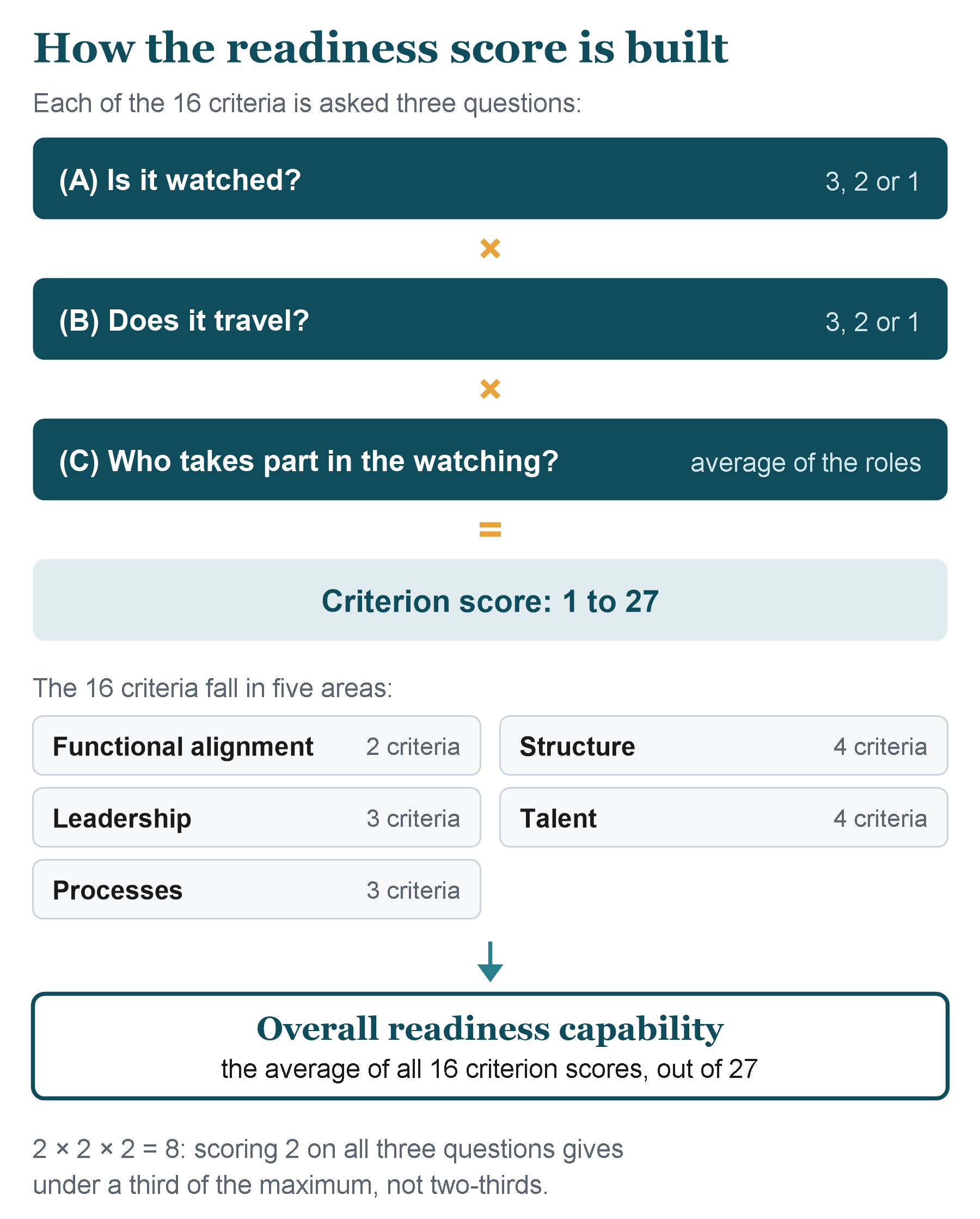
The tool linked at the end of this article asks three questions:
- Is it watched? Is there a working process that monitors it?
- Does what is learned travel? Does it go up as feedback, to the people who can decide, and come back down as an instruction, to the people who must act?
- Who takes part in the watching? Are capable people doing their part?
The three depend on one another. Monitoring that nobody takes part in is an intention, not a safeguard; findings that never reach a decision-maker are a nerve that does not reach the brain; and the finest information flow carries nothing if nothing is watched.
This is the point that surprises most readers. The tool does not score whether an organization's structure is good. It scores whether anyone is watching it, so that when it stops fitting the work, someone knows.
Five areas worth watching
The questions are asked of 16 criteria, in five areas:
- Functional alignment: whether the top role is senior enough for what the unit faces (a unit that must plan years ahead, run by a role that plans months ahead, fails this), and whether its roles do related work, rather than unrelated jobs grouped under one head;
- Structure: whether every role has one clear manager, at the right level;
- Leadership: whether a person's manager and that manager's own manager each have a defined part, and managers actually do their essential duties;
- Talent: whether people are matched to roles on capability, developed on purpose, and ready to step up;
- Processes: whether work flows without broken steps, and it is clear who decides what.
Which roles do the watching
The tool counts up to seven roles formally assigned to the watching: a process improvement team lead and specialist, an HR team specialist, the unit manager and that manager's own manager, who are always counted, and up to two roles of the organization's own. Roles an organization does not have are switched off and left out of the score, so a small organization is not marked down for being small. But the tool needs at least two levels of management: an organization of only front-line staff and a single manager is not badly run; it is simply below its scope.
Why the scores multiply
Each criterion is scored 3 when it is available and functional, 2 when it is available but not fully functional, and 1 when it is not available. The three answers are multiplied, not added, so a single 1 caps a criterion at 9 of 27.
What the score tells you
| Score | What it means |
|---|---|
| Below 8 | Reactive. The mechanisms that would let the organization see change coming are largely missing, or exist with nobody doing the watching. |
| 8 to under 18 | Partially ready. Mechanisms exist, but they are not fully functional, not fully flowing, or not fully staffed. |
| 18 and above | Monitoring in place. The next step is to verify the score against evidence rather than opinion. |
Read separately, the three questions show where the watching breaks down: an area that is watched, but whose findings do not travel, is building processes without yet using what they learn.
Score it with others
Your own ratings, multiplied three times, move with your mood and with where you sit: treat your result as a first reading, not a verdict. Then ask colleagues to score it on their own, and compare. The average says how ready it is; the spread, whether its people see it the same way. Where they differ, check the evidence. Scored every year, the results show which areas are strengthening and which are stalling. The tool points to the gaps; closing them is the work of leadership.
Where this comes from
The Readiness Assessment Tool belongs to Leading Through Change (LTC), a program for business owners, managers and HR professionals that applies the Organizational Transformation Readiness (OTR) model, founded in Elliott Jaques's Requisite Organization. Teams taking its course use a version that compiles up to ten people's answers and keeps the yearly record. A companion article, Seeing Is Not Enough, asks a related question: whether what an organization sees reaches the people who decide, in time to act. Write to me if you would like a copy, or to find out whether the course suits your organization.
Score your own organization: otrmodel.com/readiness. It runs in your browser, and nothing you enter is sent anywhere. If you want me to help you read your result, send it to me and I will be happy to walk you through it.
Sources
Christensen, C. M. (1997). The Innovator's Dilemma: When New Technologies Cause Great Firms to Fail. Harvard Business School Press.
Global Organization Design Society. Frequently Asked Questions (FAQ) about Requisite Organization. globalro.org/article/frequently-asked-questions-faq-about-requisite-organization/2360.
Jaques, E. (1998). Requisite Organization: A Total System for Effective Managerial Organization and Managerial Leadership for the 21st Century (rev. 2nd ed.). Cason Hall.
Sull, D. N. (1999). Why Good Companies Go Bad. Harvard Business Review, 77(4), 42-52.
© Nagib Choueiri. Nagib Choueiri is a freelance consultant on HR and operational transformation and the author of the Leading Through Change (LTC) program, which applies the Organizational Transformation Readiness (OTR) model.